When a few mates over Christmas suggested we should go karting, I realised it had been over 2 years since I last went to my local track! This wasn’t good enough, so this time we actually sorted it out, and turned up at Birmingham F1K to take advantage of a £20 deal for 30 mins of track time.
Last time I was there, I’d done a few sessions close to each other, and was convinced that my 27 second lap time was as good as I could drive, and my weight was the only factor left to bring my lap times down.
That said, when I’m karting I’ve always used the brakes as a bit of an on/off switch. This worked to get the kart sliding and drifting, but, as I hope we all know by now, if your tyres are sliding you’re almost certainly going slower than you could be.
On previous sessions I’d worked at making sure I’m hitting the right lines, and there’s less than an inch between me and the edge of the track so I’m using everything I can. These things alone will help you carry speed through corners – which is vital in a kart that goes ‘off the boil’ the instant you release the loud pedal. This time, I was determined to have a go at using the brake pedal a bit more lightly and progressively.
Video here:
I was a lot faster than the others on the track – which made the passing fun, but didn’t actually give me a whole lot of clear laps. And it was all just a bit of fun, so I do like to get majorly sideways and full on the throttle through a few of the corners on the track! I also wasn’t going to shove the others out of the way and ruin their enjoyment, knowing I wasn’t going to get stuck behind them for long.
I was here to work a little and get some benefit from it, though…
I remember getting a good exit onto the start/finish straight, looking over to find the track ahead clear for most of the lap, and thinking “Right, let’s get a quick one in!”.
I scrapped the drifting, and used very delicate braking for the whole lap – just to see if I could get a faster time. This was Lap 9 – and I smashed my previously ‘unbeatable’ (for me!) time by a full second! And I still weigh the same as I did, then!
The other few clear laps I had I did the fun way – which felt faster to me, and wasn’t far off that time (a few tenths in it), but never bettered that Lap 9 time.
So, experiment concluded – keep it all in line for the best times!
Of course, I’m once again convinced that I’d need to lose weight in order to beat my best time – so it’ll be fun to go back again soon, and see if I can get under 26 seconds!
A HANS (Head And Neck Support) device goes over your shoulders and around your neck, and attaches to your helmet on each side by a short tether.
It’s an ingenious invention that has saved many lives. Basically, if you hit something had head-on, the car stops dead but your head keeps on going forwards, rotating down towards your chest before pulling your spinal column out of your brain. What you may hear referred to as a ‘brain stem injury’ or ‘basil skull fracture’. And you’re dead.
A HANS device will stop your head going forward enough that your brain will stay attached to your spine, and you’ll live.
I’ve put that bluntly, because us drivers like to gloss over safety stuff, obscure them in technical language that makes it all sound colder and less personal, or we just ignore it and hope it never happens to us.
When the HANS kit first came into racing, one of the biggest opponents to it was one of the greatest NASCAR racers ever – Dale Earnhardt. Somewhat ironically, when he hit the wall head on at silly speeds, he would have almost certainly walked away from the crash had he worn a HANS device to stop his fatal and instant brain stem injury.
“Before this point, many drivers, including Earnhardt.,[5] resisted the HANS (and similar) devices, claiming them to be uncomfortable, more restrictive and fearing that it would cause more injuries and problems than it prevented. Some stated that the positioning of the device made the seat belts feel less secure or rubbed on the shoulders or collar bone. Earnhardt himself referred to the device as “that damn noose“, claiming the tethers would sooner hang him than save him in the event of a crash. The week after Earnhardt’s death, Mark Martin said Rockingham, “I would not wear one for anything. I’ll just keep my fingers crossed and take my chances”.[5] However, drivers were not willing to participate in the process of perfecting the fit, and endure the limitations imposed by such devices.”
If NASCAR is unfamiliar to you, you may know a few of these who also may well still be with us if they’d worn a HANS: Ayrton Senna, Roland Ratzenburger, Blaise Alexander, Gonzalo Rodriguez.
Many top level formulas from open-wheels to closed wheels now have HANS devices as a mandatory requirement.
There is always talk of making them mandatory in all levels of motorsport – and it’s pretty much impossible to argue anything against this ruling.
To surprise you even more, I currently do not have any plans to use a HANS device.
I mean, if I come into some money I’d have it on the list, but at present my helmet isn’t equipped with the ‘posts’ needed to attach the tethers (I’m told you can get these fitted quickly and easily to any helmet), and my budget doesn’t stretch to the £500 or so needed to buy the kit.
Yes, I am fully aware that I’m a fool.
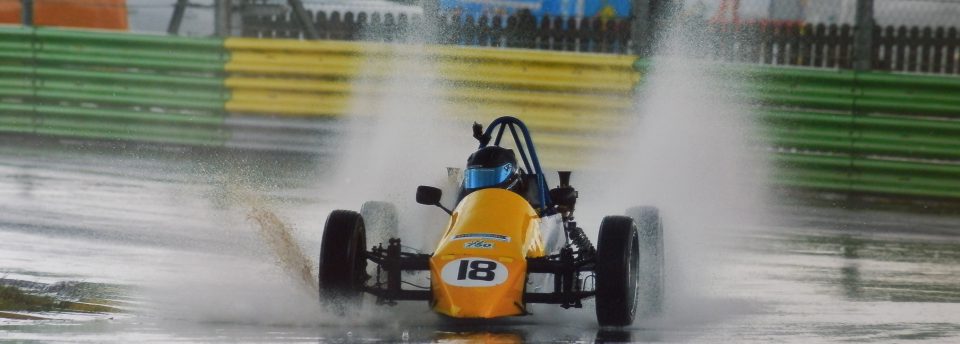
I’m not trying to pretend to myself that it could never happen to me, or that the chances of sticking a Formula Vee face-first into a wall are too slim, or that we’ve done without them for years etc.
Having said that, finally forcing myself to write all this out, I’m now thinking about it… It’s pretty much one race weekend fees for something that could very well mean you’ll be able to do it all again next weekend…
Do you use a HANS device yourself?
If not – why not?
***UPDATE***
As soon as I posted this I’d really decided that I’d be using a HANS device myself for racing. Plus my beautiful fiancee proved she does read my boring racing blogs, and gave me her ‘thoughts’ on the matter, too!
There are no arguments against using a HANS device.
Fellow Vee racer Ben Miloudi has also very kindly offered to lend me his HANS kit whilst he’s away from racing next year, so that sealed it all for me! Cheers Ben!
***FURTHER UPDATE***
Well, well. Today I saw from several sources that the MSA have actually made it mandatory for drivers of any single seater racing car manufactured after 01 January 2000 to wear a HANS device. This will come into effect from 01 January 2015.
They’ve also made it very clear that they recommend them for pre-2000 cars, too (Glenn’s Formula Vee Sheane that I drive would be exempt), and added that from 2016 all single seater drivers will need to be using a HANS.
This is good for all of us, and fair play to the MSA and FIA!
The original plan was to do this before jumping in the Vee, and then I would have a benchmark for driving a single seat racing car. I couldn’t book the day up until AFTER I should have had my first Vee race, but as it turned out, this all righted itself.
So I was up bright and early yesterday to be at Silverstone for 08:20 am.
The ‘Experience Centre’ is easy to find at Silverstone (just follow the signs to the right and over the bridge), and presenting a valid road license for signing on was quick and easy.
I’d taken my full race kit, but didn’t want to look like a Tit-Head, so decided to sign in and check out what everyone else was wearing/carrying. Nobody had anything at all with them, so I decided I’d use my own helmet, gloves and boots, but my three-layer race suit would be overkill. Silverstone provide gloves and helmets free of charge – but if you’ve got your own kit, you may as well use it!
There’s a half hour driver briefing with a video covering all the essentials like racing lines, flags, the track and braking and turning points/cones. It’s very good for novices, but if you hold a race licence you should really know this stuff already! The main difference from the ARDS test briefing was probably that you’re expected to do all your braking before you turn in to the corner.
Also, you can’t overtake anywhere on the track apart from on the straights and only on the left. The marshalls will show a blue overtaking flag to the car in front, who is expected to accelerate ‘more gently’ out of the corner to allow the car behind to pass safely. This does work wonders for safety, as you know nobody is going to try to come past you on the brakes, or pull a block pass mid-corner. The day works incredibly well because of this.
Next you go over to the Stowe infield circuit and meet the cars.
They’re special ‘Formula Silverstone’ cars – a 1.6 litre Ford Duratec engine and four gears on the right hand side, with treaded tyres and wings. They look the part, and I noticed the bodywork was pretty heavy duty, which I’m sure is part of having reliable cars that any old numpty can jump in and thrape around a circuit!
The cockpit was quite spacious, and much easier to get into and out of than the Sheane Formula Vee, but you felt very safe and secure even just using a four-point harness.
It’s a full racing clutch – so pretty much an on/off switch! You need to rev to around 5000rpm and very gently ease the clutch out until it punches you in the back and away you roar!
When I first slid into the cockpit I realised how much confidence I’d lost after spinning the Sheane. I had a bitter metallic taste in my mouth from adrenaline, and realised I’d put myself under serious pressure not to cock this up, and to prove that I actually CAN drive a racing car. I was much more nervous than sitting in the Vee for the first time.
All the cars went out in small groups, following single file behind an instructor in a Renault Clio. I was the lead car in my group, so headed out at what felt like a very slow pace.
Much like a Vee, you only really use first and second gears to get going, and the whole of Stowe was third and fourth gear.
After a few laps slowly building up the pace, we came into the pits, a different lead car went behind the Clio, and we went out again.
This pace was actually pretty perfect for all levels of driver. If you’re brand new to it all, you won’t be intimidated, and have plenty of time to learn the track and racing line. Even for me, once again having my Tom Cruise ‘crisis of confidence’, it settled me right down so I could concentrate on getting the feel of the grip and the responsive throttle.
Once more we came back to the pits, and then were let loose for the last 20 minutes on our own!
When you push the throttle down properly, it all gets a lot more hectic.
With the revs up you’re instantly lapping the circuit in less than half the time, and having to really stand on the brakes coming off the straights.
Out the pit lane you come down to an awkward entry to a left hairpin, with a late apex meaning you feed the power in onto the longest straight. Then you realise you’re being a wuss and squeeze the pedal more.
It’s a fair feeling of speed and a very bumpy journey as you ease the brakes on before you get to the ‘Brake Now!’ board, kicking yourself for not leaving it 50 metres later even as you slam it down to third gear and turn into the corner.
As you exit you drag it back to the left and dab the brakes again for a right hander, leading into a complex of corners all in third gear, some requiring a dab of brakes as you get later on in the session and pick up speed.
There’s another really awkward entry to the other hairpin, and it’s begging you to turn in too early, so you hold off and look for the yellow apex cone and bring it in to that, building power through a lovely left hander that snaps right onto the pit straight as you scream the revs up to fourth gear, braking hard but keeping as much speed as you can through a right-left s-bend back down to the first hairpin.
I was there to have fun, and pushed a fair bit with a few wiggles, but don’t think I ever strung a decent lap all together without hitting traffic (or missing a gear!), which I wish I’d concentrated more on, because in the debrief they hand you a printout of all your lap times!
I did ok, and I’m happy with my performance because I know there was a lot more to come.
As mentioned before, it ironed out some confidence issues both with driving itself, and also the big fear mentioned in previous blogs that my braking would be a major weak point. It wasn’t, and I was very comfortable with it, and willing to push much further than expected.
On about the only clear lap I had, I put in a 1:04, and although I did get caught in a fair bit of traffic, it looks like I got lucky with a very fast group, so didn’t get held up nearly as much as I’ve seen watching other peoples videos. That’s the chance you take with arrive-and-drive things.
So I’m feeling good about driving, and that should get me through to next years Formula Vee campaign. Shame there weren’t any spaces in the next session, or I may have had another go…
The full experience is available from Silverstone for around £199 – but you’ll find loads of vouchers, offers and cashback around to bring that down to around £140 – I bought mine through www.buyagift.co.uk. Then there’s the £20 damage waiver (it means you pay nothing if you kill the car), CD of top quality photographs for £20, and £30 for a full video of the day on a USB stick (plus you get £5 off the photographs with this). Not cheap, but welcome to motor racing!
Anyone following me on Twitter and Facebook will already know that This Did Not Go Well.
Basically, the engine seized on the 3rd corner on my first ever lap, and unfortunately that means it’s season over for us!
I mentioned in my blog about the ARDS test that I have absolutely no frame of reference for driving a car on track, and although this didn’t contribute to the death of the engine, it did lead to my first spin.
I spent literally two minutes stalling the car in the paddock before deciding to hit the track and go for it.
Leaving the pit lane I dropped it into 4th (top) gear with the aim of cruising around for a few laps. The tyres were not only cold, but hadn’t done a lap for 6 years.
It was here I also realised I hadn’t adjusted my mirrors! I couldn’t reach to sort them out properly, and could see a little, so thought I’d cruise around and pull into pit lane at the end of the lap to sort them out.
I turned through the first corner and saw some cars coming up fast behind me, and at the top of the Craner Curves a Ginetta G55 flew past me very close. As a biker who loves filtering, this didn’t phase me, but pulling such a close pass on a Novice in the opening minutes of a test day did seem a little harsh.
No matter, I stayed in 4th through Old Hairpin, and on the exit the back stepped out.
Now, this was my first time ever driving the car. I had no idea if I could go into that corner at 30mph or 130mph safely. I honestly thought I was cruising at about 50% of the cars ability, so wasn’t expecting any loss of traction at all. I took Old Hairpin FAST when I was last there on a bike!
From there it all happened very quickly. I though it had just spun before I’d had a chance to do anything. It was only when I watched the onboard video that I saw that I HAD corrected the slide on instinct, and kept a good constant throttle.
I’ve been drilling “Correction – Recovery” into my head for about a year. Correct the slide then bring the wheel back to recover, so you don’t spin the other way.
The problem is I have no idea what the steering is like on this car, and as it came back into line I cocked it up and around it went.
Whee!!
I stalled it during the spin just before I remembered to get the clutch in, but caught it nicely so I ended up facing the right way and was hitting the starter button before I’d stopped spinning.
It didn’t start, so I thought it might be because I was still in 4th gear, so fumbled into first and it took a few tries before the engine roared back to life.
I felt like an idiot for spinning on a damned out-lap, but I guess I was asking too much of the car/tyres without knowing it.
I was still perfectly calm (even with cars whizzing past me as I was stationary in the middle of the track!) and wasn’t having a flap. I’d just take it even easier for a few laps and be ready to catch the back if it stepped out again.
I gave a stab of throttle and eased off the clutch, and it went about 10 yards and then died.
Thinking I’d stalled it somehow, I used the momentum to pull over to the right hand side of the track out the way and hit the starter button again.
*CLUNK*
I tried a few more times but just got the clunk. I figured the battery must be dead, and got my hand in the air to let the marshalls know I had a problem.
They red-flagged the session, and I got towed back to the pits by the Wagon Of Shame feeling like a right dick-head…
Glenn knew instantly that the engine had seized, and getting a spanner on it confirmed it was locked solid…
We think it’s either a piston or main bearing, but we also had a very tight tolerance on the crank (or cam? Hell, I just drive the thing!) which could also have failed under load for the first time.
Either way, our test day was over. And with no time in the car, even if we could get it fixed for the race on Saturday, we thought it best to withdraw our entry.
So that’s all for 2014 for me! Gutted, but that’s racing!
We’ll make sure I get some proper time in the car to get the feel of it in early 2015, then will be able to think about doing a full season.
I hope you’ll continue to follow my progress, and thanks for all your support!
This video isn’t the proudest of my life, but I’m giving you the warts and all tale of my journey into racing, so it’s only fair you get to see this:
Note: This blog was first published 21 October 2012.
“So what was it like to drive a car on a race track?”
Well, I wish I’d had more laps!
Two days after my ARDS test, I’m sat here watching the British Touring Car Championship and my adrenalin is going mental. How can fate put me on a racing track for the first time (in a car) and then say “Well, actually you might get another go next year at some point.”?
Very frustrating!
It was essentially a road car I was in at Silverstone. I didn’t know that they’re supposed to be pretty rapid cars until afterwards – 2 litre turbo with 225hp. One of the hottest Hot Hatches around. I thought it was a bit slow…
I had a Hell of a lot to take in, and many things to adjust about the way I was driving.
I made sure I was trying to use every inch of the track – keeping right to the edge on the corner entry, getting two wheels up over the curb on the apex, and then drifting out with two wheels over the exit curb where it was safe. The racing line is where you will make up most of you time, especially on a damp, greasy circuit like it was all day long.
I know I could make up a few seconds a lap straight away on the brakes just by braking later and harder. I could make up more seconds by pushing harder in the corners, as I had more traction to go.
But that’s where I’m kind-of in unknown territory!
I have no comparison. I know it’s advised to go at 80% of your ability on the test, but where was I?
50%? 100%?
As I’ve never done it before I have absolutely no idea. Thinking about it, nobody else overtook me all day – apart from two sideways Nissan 350z’s driving by those super-fast Playstation 3 Nissan GT Academy geeks. I did try to hang on to the back of them but I just got a bit more ragged, and as soon as we hit Hangar straight their 125hp more took them well away.
I overtook some of the others, but that doesn’t really tell me much because I don’t know how hard they were pushing. I didn’t get a chance to actually follow anyone around, which is a bit of a shame. Or a good thing? Who knows!
One thing I am well impressed with, is that when the time came to string my test laps together I instantly dropped into The Zone. A huge calm came over me, and I was totally relaxed and focused. Even my breathing was perfect and normal – not hyperventilating or holding my breath at all.
That bodes very well for the future. If I CAN drop into that state at will, then it means I can think clearly and feel everything that’s going on, rather than feeling rushed and having get by purely on reactions.
I’m hoping the actual feel is much better in a Formula Vee single seater. I expect it will all feel much more accurate and less detached than a hot hatch, and I think I’m ready to have that.
Compared to a riding a bike on track… I don’t want to say driving a car is ‘easy’… but it’s far less busy. Because I’m used to having to brake from 170+mph and deal with acceleration of 0-60 in under 3 seconds, plus having massive forces working against your whole body the whole time, actually getting a car around a track is far less challenging.
Of course, getting a car around a track faster than 30 other people will be a whole new ball game, and the difference between a respectable pace and pushing right to the performance limits will be massive.
I know now that I can at least string some solid and consistent laps together, and that’s a huge relief.
It’s a base.
I’m looking forward to seeing what kind of balls it takes to jump off that base, and what kind of rush it gives me!
After lunch was where it would all matter. I’d expected to have a LOT more laps in the car in the morning to get used to it, but apparently not!
We all went into the classroom, watched the ARDS video to refresh ourselves, and immediately took the written test.
The first section was all about knowing the flags, and stating which flag you’d expect to see in a given situation, and whether it would be waved or stationary.
Easy – except I had problems remembering if a red flag would be waved or stationary or whether it mattered! And then brain fade about the ‘mechanical failure’ flag as to whether it was black and orange or black and yellow! ARGH!
The rest were very obvious multiple choice questions, such as:
Your car is on fire. Do you:Pull over by a crowd of spectators.Stop in the middle of the track.Pull over near a martials post so they can use their fire extinguishers to put out the fire quickly and safely.Jump out of the car and dive in a nearby toilet.
It took about 15 minutes to do the test, then we split into the same groups again – mine was first out on track as the others headed off to rag a Caterham with bald tyres around for some more skid control.
Back in the 2.0 litre turbocharged Mégane Renaultsport 250, and I’d decided to slow everything down. The track was still wet and greasy (did I miss that excuse out before?), so I braked nice and early (and pretty lightly) and went back to one of the best ways to ride a bike fast on track – make sure you’re inches from the edge of the tarmac and concentrate on hitting the inside curbs in the right place.
Doing this and being conscious of progressive braking without any lifting off and on again, I think I was going immediately faster than the morning session.
I’d become familiar with the track – apart from one moment trying to take a left hairpin on a fast right sweeper! Meh! I stayed on and corrected it without disaster… Good job, too! There was no £20 damage waiver available, so we’d be liable for all damage to the cars!
I was feeling much better as we came back in for the short break as my instructor took the other pupil out for his laps.
Back in the car and Neal talked me around a couple of laps before telling me he was going to shut up and let me get on with it as he marked me. I had to string about 5 laps together flawlessly.
A calm came over me and I went totally relaxed, breathing steadily. In the zone 100%.
I braked into the first corner and slipped it straight into bloody 6th gear again for the exit! NOOO!!!
I didn’t let it rattle me and sank straight back into the rhythm.
They say you should drive at around 80% of your ability and concentrate on being smooth. That wasn’t working so well for me earlier, and I’m totally sure those assessed laps were by far my fastest of the day.
There was a Ferrari and Aston Martin out on track driven by people on ‘Experience Days’, and they may well have been surprised as my little Mégane sailed past them!
I even overtook a few others in my group, with a rather lovely shimmying drift as I passed around the outside of someone on a fast sweeper – I watched the instructor out the corner of my eye hoping he hadn’t noticed! I kept it all controlled, though, so figured I’d be ok with that one!
After a few laps he told me to pull in and head back to the Experience Centre, and started marking my score sheet as we sat outside.
I could see a lot of A’s mixed in with a few B’s as he graded everything from mechanical sympathy to gearshifts to lines.
He then had to tick a few boxes, and delayed for a lonnng time over one as he mulled it over, eventually ticking that, too.
He told me I’d passed, but not to tell the others as they might not have theirs yet, but put an advisory on my sheet that I would benefit from further training even though I had passed – something I totally agreed with.
I felt a bit emotional sat in the car. I mused that I might even shed a tear after my first race win!
Then I remembered I didn’t know if I’d cocked up on the written test, yet…
At least the pressure was off, and I had a good laugh booting the Caterham around for the rest of the afternoon as the others did their track test.
Arriving back after that we all got our results, and I think most of us had passed!
I even got a Novice sticker (yellow background with black diagonal cross) to put on the back of my car next year! Not bad for £400!
So I am now an Officially Licensed Racing Driver – something I’ve dreamed of since I was around two years old!
I’m also fully aware that I’m at the bottom of a very steep learning curve.
Note: This blog was originally posted 19 October 2012.
“What experience do you have?” “Loads of bike track days, and car skid control courses and, err, stuff.” “What are you going to race?” “Formula Vee, next season!”
That was the last moment I felt confident on the day of my ARDS test!
Luckily, not everyone there (there were about 18 of us) had done loads of car track days and stuff, so I wasn’t alone in my lack of experience, but then the instructors spent the next part of the morning basically telling us all we weren’t going to pass today. I guess this was a good thing, as it knocked the cocky straight out of you. Especially when you learn that Silverstone is the toughest place to pass the ARDS test (although this can also work in your favour as Race Stewards will look on you more favourably if blame needs to be apportioned for an on-track incident).
After a brief chat about the basics that we should already know (race lines, car physics, under and oversteer etc), we split into two groups – one group going off to the skid pan whilst my group were first out on the proper track.
The instructors were people I almost recognised. If I could remember their names you’d probably know a few, too. I clocked Ian Flux who I know from old Formula Vee and Tuscans but hadn’t seen him since I was tiny. He wasn’t my instructor, so no chance of favouritism there!
I got Neal. If you know who Neal is, please let me know, because I didn’t get his surname, and the sheet he filled signed I never got to take home! He was great, anyway!
So, I was literally one of the first to jump in the Renault Magane Sport test cars. The six speed gearbox felt flawless, but, not being a car I’ve ever driven before the controls were a bastard. The throttle was too sensitive, the brakes too sharp. Heel & Toe was ditched immediately – I had far too much else to worry about.
We pulled out onto the Silverstone International circuit which I have never seen before in my life and began wishing I’d looked at on YouTube. It is very fast, and not the simple 4 corner layout of the National track that I was expecting!
So that’s all my excuses. In the first session we did about 15 mins worth building up speed (instructor first for a few laps then me), and I realised I was In Trouble.
It was my first time EVER driving a car on a race track. I went into 6th gear a few times when I wanted 4th, and was braking, coming off the pedal and then braking a bit more into corners. I was feeding the steering wheel a little instead of keeping my hands at quarter-to-three. My lines weren’t terrible, but transitions were ragged and nothing was very smooth.
There was no way I would pass unless I seriously got my act together. And fast.
We had a second session for 15-20 mins and I was consciously trying to improve everywhere, plus looking through the corners and doing a respectable pace.
And I think pace was my biggest problem overall. I have absolutely no frame of reference to what a fast car is on a track.
On a bike track day I’m busy all the time. On the edge of my abilities, but not exceeding the bikes limits.
In a car it’s the opposite. Because I’m used to thinking at 1000hp-per-tonne performance levels, cars are S L O W…
I had far too much time braking into corners. I could have done some knitting and still made the corner. The car felt so much slower that it almost felt like I was coming to a complete stop before the tight corners, and then waiting an eternity to get back on the power.
Once race driving is in muscle memory and I can do it all naturally without over thinking it all, this may well work to my advantage – but it was a major problem for me here.
Neil showed me a different way to hold the gear stick to improve my changes and stop getting 6th gear by accident. Great, but this meant I had just a few laps left before the test in which to completely rewire my brain of how I’ve shifted gear on the roads for the last two years…
Next was the skid control, with the cars on cradles to simulate oversteer around a course of cones. This was no problem for me, as I have done skid control in cars before, so was more a bit of fun getting it drifting.
Going into the lunch break I knew I’d improved a lot, but I still had a massive amount of work to do on my driving.
I put my chances of passing at 50-50. 60-40 at best.
I’d have to take 10 steps back and find a solid foundation to build on to have any more chance of passing the test today…
Note: This blog was first pulished 15 August 2012.
The other morning I was chuffed to bits, having just used near-perfect heal and toe technique whilst braking for the end of the dual carriageway on my way to work!
I had decided that it wasn’t worth me learning the heel and toe braking technique, as I know far more racing drivers who don’t use it than who do.
As mentioned previously, I suspect it’s one of those big black clouds that people see as the near-impossible difference between us lesser mortals and Racing Drivers.
Either way, I figure this is worthy of a separate blog.
So what IS Heel and Toe?
Well, the basic aim is to blip the throttle as you shift down a gear, which will match the engine revs and result in a much smoother gearshift. Because the revs are better matched between gears, you don’t get that jolt as the clutch takes all the strain of equalising the revs between gears, and so the tyres are also far less likely to lose grip as you downshift already on the edge of traction.
You need to brake using the ball of your foot below your big toe, so that half of your foot is over the throttle pedal, and as you press the clutch in and change down a gear, you tilt your foot so you catch the accelerator briefly, and then let the clutch out again.
Some keep the top half of their foot on the brake and twist their foot so they touch the accelerator with their heel – hence the name ‘heel and toe’. I chose to use the side of the foot after watching some YouTube videos of how drivers like Ayrton Senna did things. You can’t argue with the technique of the best racing driver ever!
It’s kinder mechanically, but also you get that sporty WHOM-WHOM-WHOM sound which sounds beautiful through a tuned exhaust. Bonus.
On a bike it was one of the first advanced riding techniques I learnt, and I use it all the time as it’s now second nature, just like clutchless upshifting. For the two-wheel version you simply whack it down a gear with your foot and quickly flick your throttle hand to match the revs. Far easier than a car, it has to be said!
A few nights ago I got to have a proper play around tight, twisty lanes in rural Worcestershire, and got lots of practice in. My success rate of using heel and toe jumped from around 2 out of 10 shifts at the start of the week when I first tried it, to a solid 8 out of 10!
Maybe I will have mastered it enough to use it in the ARDS test?
This morning I also had my first crack at it whilst wearing my Vibram FiveFingers. Awesome. They are PERFECT for it, because you have all the essential feel plus the flexibility!
It was, however, just pointed out by a cow-orker that driving barefoot is illegal. I wonder how that would go if I got pulled over driving in the FiveFingers?
Note: This blog was first published 06 August 2012.
I’ve now got my Go Racing Pack, and am preparing to book the test!
In the pack you get a DVD of what’s expected of you for the test, which goes over lots of regulations and flags you need to know for the test, and also a fair bit of first aid. You get the ‘Blue Book’ of all contacts/rules/regs in the motor racing world along with some quick reference sheets for flags and handling techniques, a Demon Tweaks catalogue, and the application form itself.
Next step is to book up a day at Silverstone.
I have made a few observations along the way so far:
Although bike part prices are wayyy above car ones, when you get into car racing the balance shifts.
Car helmets? Unless you buy from overseas you’re looking at £300 for a cheapo, and most double that. Or in the thousands. Compare that to a bike lid that will do the job for £100…
And the flame retardant suits themselves? More than a set of leathers! You might scrape a cheap suit for £300, but just over £1000 seems to be about right – and that’s into custom-made super-leather jobbies on a set of bike leathers!
And then you need Nomex boots, gloves, and ideally a full set of fireproof undergarments head-to-toe.
Luckily, having just called Silverstone up directly, all you need for the test is comfortable clothing (as a lot of the day is in classrooms) and they provide an open-face helmet (so you can speak to the instructors and hear them yelling at you). The may let me use my bike helmet, so I’ll take this along as well – mainly to try and sneak a bit of camera footage out of the day!
The other thing catching my attention at the moment is:
Heel & Toe
Every racing driver uses this technique, right?
Wrong, from what I can tell! I’m trying to find out from various sources exactly how many use it, and is it just the fastest drivers, and so far results are inconclusive.
I know championship winners who never use it, fo example.
I mean, I use the bike equivalent (blipping on every downshift), so it would make sense for me to learn heel and toe. Probably not for the test, but for the future, certainly.
I’ve said before about how driving a car is a bit boring as it’s all in slow motion compared to a bike. Maybe this will liven things up a bit for me!
I’m enjoying watching old videos of Ayrton Senna and suchlikes working the pedals. One thing to watch for, is if you’re learning from videos of Group B rally drivers, be aware that because of the filthy great primitive turbos they used, they’d often keep the throttle wide open as they braked. This kept the turbo in the narrow sweet range when they got back on the power.
As a slight tangent to this, I recently learned that Ari Vatanen(?) drove the Lancia Delta S4 on the Portuguese GP circuit in 1984, and clocked a time that would have put him in 6th place at that years Formula One race! Is that a sign of how awesome those Group B cars were, or how good their drivers were?


 Like a ‘P’ plate – but faster!


 James Cater Racing